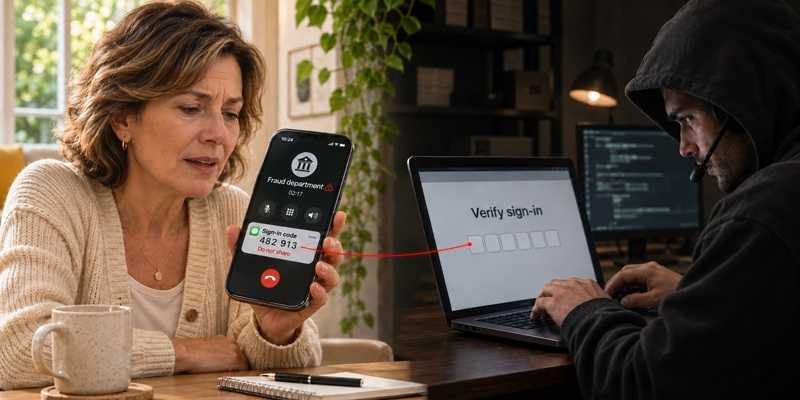
The caller sounds calm, professional, and concerned.
“There’s a suspicious transfer on your account. We can stop it, but first I need you to verify a few things.”
They know your name. They name your financial institution. Then a security code arrives on your phone, right on cue.
It feels like someone is helping you prevent fraud. Instead, they may be collecting the information needed to commit it.
This is vishing, or voice phishing. Criminals impersonate trusted people or organizations over the phone to trick you into revealing sensitive information. When they pose as your financial institution, the goal may be to take over your online banking account.
2
Scammers can manipulate caller ID to display a financial institution’s name or phone number. This is called caller ID spoofing. Even a number you recognize can be faked.
The caller may also know your address or other personal details. That information can come from stolen records and other sources. Knowing something about you does not prove that the caller works for your bank or credit union.
Professional language, a convincing explanation, and an urgent deadline are all part of the performance.
2
While the caller talks about protecting your account, someone may be trying to sign into it.
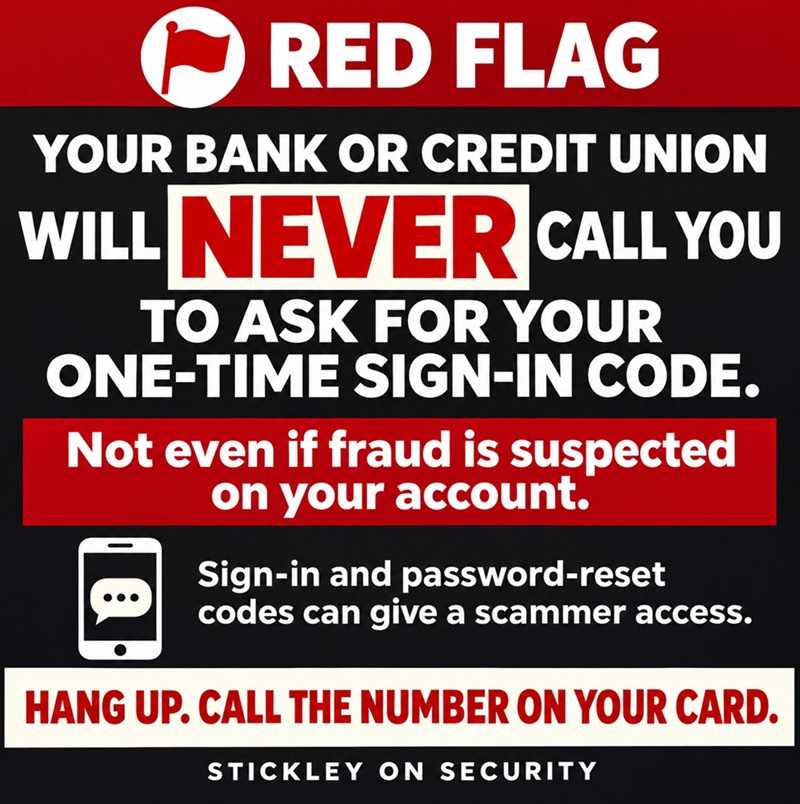
The criminal might already have your password. If so, the remaining obstacle could be the one-time code sent to your phone or email. They ask you to read it aloud, claiming it will verify your identity or cancel the suspicious activity. In reality, they use it to complete their own login. The FTC warns that scammers impersonate trusted organizations specifically to obtain these verification codes.
In another version, the criminal starts a password-reset request. The code you receive may help them replace your password and gain control of the account. The FBI has documented financial-institution impersonation schemes that use stolen credentials and authentication codes this way.
2
The criminal can trigger a real security message by attempting an action on your account. Its arrival proves that something is happening, not that the caller should be trusted.
2
Account takeover occurs when someone gains unauthorized access to your account. Once inside, a criminal may change your password, lock you out, and attempt to transfer money.
The FBI warns that stolen funds can move quickly through criminal-controlled accounts, making recovery difficult. That’s why preventing access and reporting suspicious activity promptly are so important.
2
Your financial institution may contact you about suspicious activity. You can take that warning seriously while still verifying who is contacting you.
End the call and contact your institution using the number on your payment card, a recent statement, or its official app. Don’t use a number supplied by the caller, and don’t simply call back the number in your recent calls.
The FTC also cautions against relying on the first search result for contact information, because scammers can buy advertisements displaying fake support numbers.
Once you have independently reached your institution, explain what happened and follow its verification process.
2
-
2
-
Don’t approve a login or authentication request you didn’t initiate. Read the prompt carefully.
-
Don’t follow a caller’s link to “secure” your account. Open your institution’s app or use a saved, trusted website address.
-
2
-
Don’t transfer money to a supposed “safe account.” The FTC warns that instructions to move money to protect it are a scam.
2
Contact your financial institution’s fraud department through a trusted channel. Tell them exactly what you shared or approved, even if no money appears to be missing.
Ask for help securing online access, reviewing transactions, and attempting to stop or recall any unauthorized transfers. Change exposed passwords and any reused elsewhere. Save messages, call details, and other evidence, and report account takeover to the FBI at IC3.gov. Recovery is not guaranteed, but prompt reporting can improve the opportunity to limit losses.
A convincing voice can create a false sense of security. Before you help someone “protect” your account, make sure you’re speaking to the people who actually protect it.
2
For banks and credit unions
Share this article with your members
Copy a ready-made summary and link for your newsletter, website or social posts.