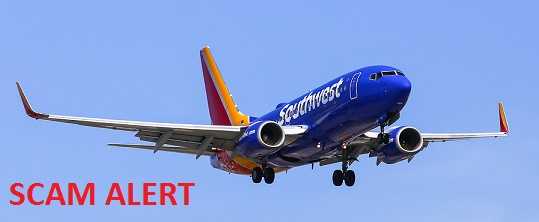
A new scam is going around on Facebook claiming that a popular airline is giving away free first class tickets for a whole year. That sounds fantastic. Of course, who would not want free travel for a year and in first class to boot? The trouble is that it's a scam.
For those who don't travel often or don't travel on Southwest airlines, it may seem like a great offer. Especially if all you have to do is fill in a few details about yourself. However, without even clicking the ad that shows up on the Facebook feed, there are several clues that it's a scam.
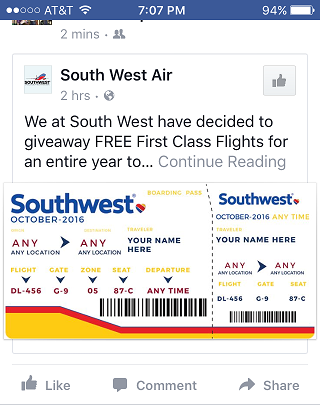 First, the airline spells its name as one word, yet the image in the ad has it as two words (South West). Next, the sentence structure and grammar are not correct and any professional company would make sure that it is before posting it. Also, Southwest does not have a first class section at all. Another clue is the boarding pass example has a "zone" for boarding and this airline does not board that way.
Of course there are other clues to the seasoned Southwest traveler, but suffice it to say that this particular one is a scam and you should not click the ad or any links you see in your social media feeds. Be cautious of clicking any such links or attachments you see in social media or in email. They are often seeking to collect details about you which could be used against you to commit fraud or identity theft.
Because of the amount of people that can be reached on various social media and networking sites, scammers often use them to collect information. Sometimes they want email addresses that can be used for spam. Other times, they want credit card details. Any time one of these ads asks for that, it should most definitely throw up a big red flag and you should not continue. Sometimes merely by clicking the ad or link, malware can get downloaded onto your device. So always use the utmost caution and remember that if it seems too good to be true, such as the scam claiming $1000 Walmart gift cards to everyone that clicked or free first class travel for a year, it probably is.
For banks and credit unions
Share this article with your members
Copy a ready-made summary and link for your newsletter, website or social posts.